
Every business transaction needs to go somewhere in your financial records. But how do you know which account to use?
Understanding the 5 types of accounts in accounting helps US small business owners track income, manage expenses, monitor debts, and prepare accurate financial statements.
These five accounting account types are assets, liabilities, equity, revenue, and expenses. Whether you manage your own books or use professional bookkeeping services, knowing how these accounts work can help you make better financial decisions.
Let’s explore each account type with practical examples and see when your business might need professional accounting support.
Let’s break them down in a way that’s easy to understand, with examples you can relate to.
What Are the 5 Types of Accounts in Accounting?
The five main types of accounts in accounting are:
- Assets: Resources your business owns or controls.
- Liabilities: Financial obligations your business owes.
- Equity: The owner’s remaining interest in the business.
- Revenue: Income earned from business activities.
- Expenses: Costs incurred to operate the business.
These accounting classifications form the foundation of your chart of accounts, general ledger, and financial statements.
For small businesses, correctly classifying accounts is essential for maintaining accurate records and understanding financial performance.
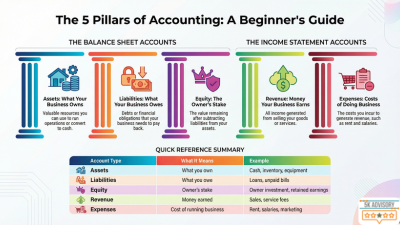
1. Asset Accounts – What Your Business Owns
Asset accounts record resources that provide economic value to your business.
Common examples include:
- Cash and business bank accounts
- Accounts receivable
- Inventory
- Office equipment and furniture
- Prepaid expenses
Small business example: A consulting company purchases a $2,000 laptop for business operations. The laptop may be recorded as equipment, depending on the company’s accounting and capitalization policies.
Why it matters: Proper asset classification helps businesses prepare accurate balance sheets and track available resources.
2. Liability Accounts – What Your Business Owes
Liabilities represent financial obligations your business must settle.
Examples include
- Accounts payable
- Business loans
- Credit card balances
- Accrued expenses
- Sales tax payable
Small business example: Your business receives a $1,500 supplier invoice but hasn’t paid it yet. Under accrual accounting, the amount is generally recorded as accounts payable.
Why it matters: Accurate liability records help business owners manage outstanding bills, plan payments, and monitor financial obligations.
If your company frequently struggles to reconcile unpaid invoices, professional monthly bookkeeping can help keep these records organized.
3. Equity Accounts—The Owner’s Stake
Equity represents the residual interest in a business after deducting liabilities from assets.
The basic accounting equation is:
Assets = Liabilities + Equity
Examples of equity accounts include:
- Owner’s capital
- Retained earnings
- Common stock
- Additional paid-in capital
- Owner’s drawings or distributions, where applicable
Small business example: If your business has $100,000 in assets and $40,000 in liabilities, its total equity is $60,000.
Why it matters: Equity accounts help owners understand how investments, earnings, and distributions affect their financial position.
4. Revenue Accounts—Money Your Business Earns
Revenue accounts track income generated through business activities.
Examples include:
- Product sales revenue
- Service revenue
- Consulting fees earned
- Subscription revenue
- Rental income, where applicable
Small business example: A marketing agency completes a project and earns $5,000 in service fees. Under accrual accounting, it generally recognizes revenue when the relevant performance obligation is satisfied, even if payment arrives later.
Why it matters: Revenue classification helps businesses measure sales performance and prepare accurate income statements.
5. Expense Accounts – Costs of Running Your Business
Expense accounts record costs incurred while operating a business.
Common examples include:
- Rent
- Utilities
- Salaries and wages
- Advertising expenses
- Insurance expenses
- Professional service fees
Small business example: Your company pays $800 for monthly office rent. The payment is generally recorded as rent expense for the applicable period.
Why it matters: Accurate expense tracking helps business owners understand profitability, monitor spending, and maintain reliable financial records.
Quick Table Summary | 5 Types of Accounts in Accounting
| Account Type | What It Means | Example (Small Business) | Financial Statement |
|---|---|---|---|
| Assets | What the business owns or controls | Cash, inventory, equipment | Balance sheet |
| Liabilities | What the business owes | Loans, accounts payable | Balance sheet |
| Equity | Owner’s residual interest | Capital, retained earnings | Balance sheet |
| Revenue | Income earned | Sales, service fees | Income statement |
| Expenses | Costs incurred | Rent, salaries, utilities | Income statement |
How Do the Five Accounting Accounts Work Together?
Let’s consider a small coffee shop.
Transaction 1: The shop sells $500 worth of coffee for cash.
- Cash increases by $500.
- Sales revenue increases by $500.
Transaction 2: The shop pays $200 in monthly rent.
- Cash decreases by $200.
- Rent expense increases by $200.
Transaction 3: The shop purchases $1,000 of equipment on credit.
- Equipment increases by $1,000.
- Accounts payable increases by $1,000.
These transactions affect different account classifications while keeping the accounting equation balanced.
For growing businesses, managing hundreds of similar transactions manually can become time-consuming.
Need Help Managing Your Business Accounts?
Are your financial records becoming difficult to manage? 5K Advisory provides outsourced bookkeeping and accounting services for US small businesses, helping owners organize transactions, reconcile accounts, and maintain accurate financial records.
Why Proper Account Classification Matters for Small Businesses
Correctly classifying accounting accounts helps businesses:
- Prepare accurate balance sheets and income statements.
- Track outstanding customer payments and supplier bills.
- Monitor revenue, expenses, and profitability.
- Maintain organized records for tax preparation.
- Identify bookkeeping errors before they affect financial reports.
Misclassified transactions can distort financial statements and make business decisions more difficult.
For example, recording a loan received as sales revenue can overstate business income. Similarly, treating a qualifying equipment purchase as an ordinary expense can affect reported profit.
This is why businesses often seek professional accounting services as transaction volumes increase.
When Should a Small Business Hire an Accountant or Bookkeeper?
Understanding account types is useful, but maintaining accurate records requires consistent bookkeeping.
You may benefit from professional support when:
- Your monthly transactions are increasing.
- Bank reconciliations are falling behind.
- Your financial statements contain unexplained balances.
- You need reliable monthly financial reports.
- You are preparing business income tax returns.
- You want to outsource routine bookkeeping tasks.
A bookkeeper generally handles transaction recording, reconciliations, and routine financial records. An accountant may provide additional support with financial reporting, adjustments, analysis, and tax-related accounting work.
Looking for Outsourced Accounting Services?
Whether you need monthly bookkeeping, financial statement preparation, or ongoing accounting support, 5K Advisory helps US small businesses maintain organized financial records and improve financial visibility.
FAQs About Types of Accounts in Accounting
Do I need all five account types for a small business?
Yes! Even freelancers and solo entrepreneurs benefit from tracking assets, liabilities, equity, revenue, and expenses. It keeps your financial picture clear.
Which types of accounts appear on the income statement?
Revenue and expense accounts appear on the income statement. They help calculate profit or loss for a specific reporting period.
Where do these accounts appear?
- Balance Sheet: Assets, Liabilities, Equity
- Income Statement: Revenue, Expenses
What are the different types of accounts in accounting with examples?
The five main types are assets (cash), liabilities (loans), equity (owner’s capital), revenue (sales), and expenses (rent). Each category contains accounts relevant to a business’s activities.
Which of the following is not a classification of an account category: asset accounts, equity accounts, cash accounts, or liability accounts?
Cash accounts are not one of the five main classifications. Cash is a specific account within the asset category.
Do small businesses need professional help classifying accounts?
Not every business needs an external accountant for routine classification. However, professional bookkeeping or accounting services can help when transactions become complex, reconciliations fall behind, or financial reporting requires additional expertise.
What are examples of revenue accounts?
Common revenue accounts include sales revenue, service revenue, consulting fees earned, subscription revenue, and rental income.
Final Thoughts | 5 Types of Accounts in Accounting
Understanding the 5 types of accounts in accounting is an important first step toward better financial management.
Assets, liabilities, equity, revenue, and expenses help businesses organize transactions, understand financial performance, and prepare financial statements.
However, knowing the categories is only part of the process. Consistent recordkeeping, accurate account classification, and timely reconciliations are equally important.
5K Advisory provides bookkeeping and accounting services for US small businesses that need support managing financial records, preparing reports, and keeping their accounts organized.
Если вы ищете рейтинг юридических компаний по банкротству физ лиц, то рекомендуется изучить тщательно их предложения и отзывы перед выбором подходящей организации.
Многие граждане сталкиваются с необходимостью признания банкротства по личным причинам.
Одним из лидеров в этой сфере является компания «Банкротство Легко».
Она предлагает комплексный подход, начиная от консультаций и заканчивая полной процедурой оформления документов.
Еще одним заметным игроком является «Финансовый Старт».
Преимущество «Финансового Старт» — это быстрое выполнение процедур и личный подход к ситуации каждого клиента.
Третье место занимает «Юридический Центр Банкротства».
Фирма обеспечивает сопровождение на всех стадиях процесса, защищая интересы клиента.
Объем рынка по банкротству физлиц включает несколько ведущих фирм, заслуживающих доверия.
Выбор подходящей компании зависит от потребностей и ситуации клиента, а также от репутации специалиста.
Обращение к опытным специалистам — залог успешного завершения процедуры и минимизации рисков.