
Understanding the 5 types of accounts is one of the most important skills for US small business owners, students, or anyone learning accounting basics. These five categories — assets, liabilities, equity, revenue, and expenses — are the backbone of every financial statement and help you track where money comes from and where it goes.
Let’s break them down in a way that’s easy to understand, with examples you can relate to.
What Are the 5 Types of Accounts in US?
The five main account types are:
- Assets
- Liabilities
- Equity
- Revenue (Income)
- Expenses
These are the backbone of every financial statement, from balance sheets to income statements. Understanding them is the first step to confident financial management.
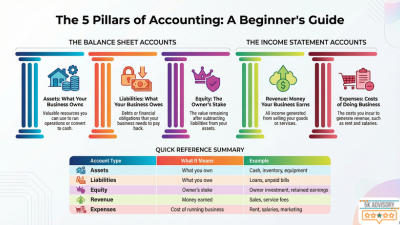
1. Asset Accounts – What You Own
Assets are resources your business owns that have value. Think of anything you can use to run your operations or convert to cash.
Examples:
- Cash in your bank account
- Inventory (products you sell)
- Equipment or office furniture
Why it matters: Knowing your assets helps you understand your company’s true value.
Quick tip: Assets are usually listed on your balance sheet, and they always increase when you gain resources.
2. Liability Accounts – What You Owe
Liabilities are debts or obligations your business needs to pay.
Examples:
- Business loans
- Credit card balances
- Unpaid bills to suppliers
Why it matters: Tracking liabilities prevents surprises and helps you plan for repayments.
Quick tip: Liabilities also appear on your balance sheet and increase when you take on new obligations.
3. Equity Accounts – Owner’s Stake
Equity represents the owner’s share of the business. It’s what remains after subtracting liabilities from assets.
Examples:
- Owner’s investment in the business
- Retained earnings (profit kept in the business)
Why it matters: Equity shows your personal stake and the overall financial health of your company.
Quick tip: Equity can increase when the business earns profit or when you invest more money into it.
4. Revenue Accounts – Money You Earn
Revenue is the money your business earns from selling goods or services.
Examples:
- Sales from a coffee shop
- Service fees for consulting or freelancing
- Online product sales
Why it matters: Revenue is the starting point of profit calculation. The higher your revenue, the more money your business can reinvest or save.
Quick tip: Revenue accounts are listed on your income statement, not your balance sheet.
5. Expense Accounts – Cost of Running Your Business
Expenses are the costs incurred to run your business and generate revenue.
Examples:
- Rent and utilities
- Employee salaries
- Marketing or advertising costs
Why it matters: Keeping track of expenses helps you control spending and identify areas to save money.
Quick tip: Expenses are also on the income statement and reduce your profit.
Quick Table Summary | 5 Types of Accounts in Accounting
| Account Type | What It Means | Example (Small Business) |
|---|---|---|
| Assets | What you own | Cash, inventory, equipment |
| Liabilities | What you owe | Loans, unpaid bills |
| Equity | Owner’s stake | Owner investment, retained earnings |
| Revenue | Money earned | Sales, service fees |
| Expenses | Cost of running business | Rent, salaries, marketing |
How These Accounts Work Together
Here’s a simple example:
- You sell $500 worth of coffee. Cash (asset) goes up $500, and revenue also goes up $500.
- You pay $200 for rent. Cash (asset) goes down $200, and expense increases $200.
This is the basic flow of money and how accounts interact. Knowing this makes bookkeeping and financial reporting much easier.
Read More About: Top Accounting Firms in USA and Benefits of Accounting Services
FAQs | 5 Types of Accounts in Accounting
Do I need all five account types for a small business?
Yes! Even freelancers and solo entrepreneurs benefit from tracking assets, liabilities, equity, revenue, and expenses. It keeps your financial picture clear.
Where do these accounts appear?
- Balance Sheet: Assets, Liabilities, Equity
- Income Statement: Revenue, Expenses
Can I manage these accounts without an accountant?
Absolutely. Many small business owners use simple accounting software like QuickBooks or Xero to track these five account types.
Final Thoughts | 5 Types of Accounts in Accounting
Mastering the 5 types of accounts is the foundation of good financial management. Once you understand them, you’ll:
- Track money accurately
- Make smarter business decisions
- Prepare for taxes or audits confidently
- Understand your true financial health
Start by reviewing your current accounts, categorize them correctly, and you’ll see your financial picture clearly — no guesswork needed.